


The judge in the Astapa case, regarding corruption in Estepona Town Hall, has more than 40 million € belonging to the 99 indicted in the case frozen, and Hacienda has detected a missing 20 million from appraisals on four real estate deals. These are named a El Ángel, Valle Romano, Arroyo Enmedio Este and Camino del Cerrillar. The case summary shows that as many as 1,800 properties have been impounded in the case, along with 50 vehicles, and a stud with 38 horses. One of the papers dated December 2010 shows that police have requested information from more than 100 local companies, most of them hotels, banks or builders and from what was obtained have concluded that the Town Hall and the political parties organised events and other items paid for by third parties, or by the people alleged to be at the centre of the case. El País reports that the ex Chairman of the Caja Jaén is among those implicated for bribery. José Antonio Arcos Moya, is alleged to have been involved in the payments surrounding concessions made by the Town Hall in 2007 regarding the first occupancy licence for La Reserva de Selwo Golf S.L. The case summary notes the high life style of the ex Councillor, José Ignacio Crespo and says there are indications that he received a 40,000 € payment from a company with town planning interests in the town. The tax authorities are investigating more than 120 companies and individuals and the police continue to wade through 160 boxes of files and 100 hard disks of information.
 Lawyers for a woman who alleges she was sexually assaulted by Prince Alwaleed bin Talal of Saudi Arabia say the case has not been properly handled by Spain's criminal justice system. The woman, known only as "Soraya", says she was assaulted on a yacht moored off the island of Ibiza in 2008. A spokeswoman for the prince denied the allegation and said he had not been to Ibiza for more than a decade. The case was shelved by an island court but has now been reopened. This followed a successful appeal by Soraya's lawyers. The judge is preparing a second official request to the Saudi authorities for assistance in formally questioning the prince. The nephew of Saudi King Abdullah, Prince Alwaleed bin Talal is a multi-billionaire with major investments in both Citigroup and NewsCorp. 'Something in my drink' "In our opinion, the Court of Instruction No 3 in Ibiza and the police did not follow full procedure in cases of alleged sexual abuse," the lawyers from Madrid-based firm Turiel and Beloqui told the BBC. "There are things that should have been investigated that were not - like questioning staff on the yacht and the guests, an analysis of the victim's clothes and so on," the lawyers wrote, describing the fact these steps were not taken as "very unusual". The claim that the case was not being pursued with proper rigour was dismissed by the Ibiza court in 2010, saying that the identity of the accused in no way affected its decision to drop the case that year. The court ruling cites insufficient evidence to proceed. Continue reading the main story “ Start Quote My daughter was in a terrible state, [...] scared to death, crying, awful” Mother of 'Soraya' Soraya, a Spanish-German model, was 20 at the time of the alleged attack on 13 August 2008 on board the 117-metre luxury yacht Turama. She told police she had begun to feel nauseous in the VIP zone of a local night club, where she believes something was slipped into her drink. She had been taken there by a man claiming to be a chauffeur for "an Arab prince" who was visiting the island. According to court documents seen by the BBC, Soraya sent the chauffeur an SMS text message at 05:12, saying: "I haven't drunk much but I think there was something in my drink." The model says she came round some hours later on board the Turama to find a man on top of her. She later identified the man as Prince Alwaleed bin Talal using images taken from YouTube. Forensic reports from a medical examination the following day revealed traces of a sedative and semen, but no physical injuries. A woman identifying herself as the mother of Soraya told the BBC her daughter had called on the morning of the alleged attack asking her to come and collect her from the island. "My daughter was in a terrible state, [...] scared to death, crying, awful," the woman said, responding to questions sent by email. "The Spanish justice system has treated this case very badly. In my view they did not want to get too involved because of who the accused was." A 2010 prosecutor's report says three men who were questioned by police during the investigation were unable to corroborate the model's version of events "in any way". The Saudi foreign ministry rejected an initial request from the Ibizan court to investigate, citing "an inability to identify the accused and a lack of solid evidence". This week, a spokeswoman for Prince Alwaleed's Kingdom Holding Company said the prince had never been informed of the 2008 court case, or that it was eventually shelved. In a statement, she also said the billionaire's travel records confirm he was with dozens of friends and family at the time of the alleged attack, nowhere near Ibiza. "There have been many examples of people impersonating Prince Alwaleed over the internet and elsewhere for their own purposes," Heba Fatani said in a statement. She called the allegations against him "salacious" and "completely and utterly false". The Audencia Provincial court in Mallorca - which has jurisdiction over Ibiza - has ordered the case to be reopened in order to ensure the prince can be questioned in accordance with Spanish law. Soraya's lawyers have urged him to provide a DNA sample to rule himself out of the inquiry.
 Spain today became the latest European country to hike taxes on the wealthy, with a new asset-based tax targeting the country's richest people. Spain's socialist government hopes that the new wealth tax will raise up to €1bn in a country where growth is grinding to a halt and this year's 6% deficit target looks increasingly tough to meet. The move represents a U-turn for prime minister José Luis Rodríguez Zapatero, who abolished a similar wealth tax in 2008 — just before the country plunged towards recession. "The economic crisis makes it necessary to bring this tax back, applying principles of fairness so that those with bigger assets can be taxed and so those who have greater wealth can contribute more to getting the country out of the crisis," a finance ministry statement said. Spaniards with €700,000 of assets in real estate – excluding their main home – as well as in stocks and bank deposit will have to pay the new tax. "It excludes the middle classes, who were the ones who had been largely affected by it when it was eliminated in 2008," the statement said. "We estimate the number of people who will contribute at around 160,000, with annual payments of about €1.08bn if it is applied evenly across Spain," it added. The wealth tax will go to Spain's cash-strapped regional governments, though some of them are opposed to it. Only one of the eleven regions currently governed by the right-wing opposition People's Party (PP) has so far indicated that it will apply the tax. It remained unclear how many others, including the wealthy Madrid region, would join the PP-administered region of Extremadura. But with fierce austerity measures in place, PP regional governments will come under intense pressure to use the tax. "In moments of hardship it is fair that those who have more should give more, just as some of the wealthiest people in Germany and France have offered to do, especially as they are less affected by measures that have been applied to pensions, salaries, lay-offs and income tax or VAT hikes," said José María Mollinedo, head of the tax inspectors' union. Spain's wealthy largely avoid income tax, with only some 7,000 people declaring annual taxable income above €600,000. Emilio Botín, head of the Santander banking group and Spain's tenth wealthiest individual, said that he disagreed with the move. "I think it's bad," he told journalists
 Back in early September, the recruitment committee of the Council of Saudi Chambers of Commerce and Industry announced that recruitment companies would be established and will be licensed to bring in housemaids from Morocco, East Asia and South Africa. The move has caused outrage in unusual places. The reason for this recruitment move, according to a Saudi chamber official, was that they were turning to Morocco and other countries to get its domestic workers following a dispute with the Philippines and Indonesia, the largest suppliers of housemaids to the Gulf countries. The dispute has centered on pay and conditions, but Indonesia had earlier this year also criticized the Saudi government for beheading an Indonesian maid. Of the 1.2 million Indonesians working in Saudi Arabia, over 70% are domestic helpers. The ban on maids from Indonesia and the Philippines hit Saudi households hard, causing many to resort to hiring illegal maids over Ramadan. The Saudis are reliant on foreign workers to perform their household tasks for them and very few Saudi women will work in such menial positions despite high unemployment, as they would be looked down on by other Saudis. The ban came into effect following the two countries attempts to introduce regulations for the work conditions of their nationals. Trade Arabia said both countries demanded better working conditions for their employees. Saudi walked away from the negotiations abruptly and decided to look for domestic employees from countries such as Morocco who they perceive as not as concerned about imposing regulations to protect their workers. It also became clear that lower rates of pay could be offered to other nationals. Right from the beginning the scheme ran into problems in respect to recruiting maids from Morocco. The recruitment committee said that the immediate employment of Moroccan maids could prove an issue as there were no official recruitment offices in Morocco to process the papers of prospective domestic helps. It was suggested that there could be a way around the problem with Saudi citizens being given work visas to bring housemaids from Morocco on their own. The whole issue of Saudi maids has been at the centre of international protests for years, especially in regard to exploitation, sexual harassment and torturing of foreign housemaids. The notion that individual Saudi's could fly to Morocco and find a young woman and take her back to Saudi, is truly worrying and will, no doubt, offend our readers. The chairman of the Council of Saudi Chambers of Commerce and Industry, warned Saudi citizens against contacting any offices claiming to be able to send housemaids from Morocco to the Kingdom. "They are all fake. You should not heed the false claims of these fake offices." he warned prospective employers. The spokesman of the Labor Ministry, Hattab Al-Anzi, said the recruitment offices would grant citizens work visas for housemaids from Morocco. "It is now the responsibility of the citizen to look for authorized private recruitment offices to bring workers from Morocco," he said. Then, suddenly, the plan to import maids from Morocco ran into even more problems. Those fighting to stop the "maid-trade" got support from an unlikely source - Saudi women. They objected to the importing of Moroccan girls, not because they didn't think they would work hard, or that they were against the exploitation of young foreign women. No - it was because they thought the Moroccan women were too beautiful. At first it sounded like a sick joke, but the Saudi women were serious. "Many Saudi woman have objected to plans to import domestic workers from Morocco…they say the Moroccan women are beautiful and this will cause continuous anxiety and concern in Saudi families,” - 'Sharq' Daily It is a relatively rare for the voices of Saudi women to be raised in protest. This year there have been notable exceptions as some women protested for the right to drive, whilst others demanded the right to vote. Now they have another common cause - to ban female domestic maids from Morocco. It started slowly, but over a few days the protests grew to the point where the Saudi women inundated the government with complaints that Moroccan women are just too beautiful and may lure their husbands away. According to the website Emirates 24 the Shura Council was “deluged by demands from Saudi women” "Moroccan women are so attractive that their husbands could easily fall for them…others said Moroccans are good at magic and sorcery and that this could enable them to lure their husbands.” - 'Sharq' Daily If the women of Saudi Arabia fail to stop this "maid-trade" then it is imperative that the Moroccan government scrutinize the contracts and conditions of every maid taken to Saudi. They should also take steps to educate Saudi women to understand that while Moroccan women may be beautiful, they are not dangerous.
 Málaga Singer, Pablo Alborán, who had a surprise number one album in Spain this year has been nominated in three categories of the Latin Grammys, including best new comer and song of the year for ‘Solamente tu’. When he heard the news the Málaga singer wrote on Twitter – ‘Family, I don’t know what to say. This is a dream, I love you!’. Shakira, Ricky Martin and Maná also have three nominations this year. Grand favourites at the Latin Grammys this year are Calle 13, a due from Puerto Rico who have as many as ten nominations. The ceremony will be held in Las Vegas on November 10.
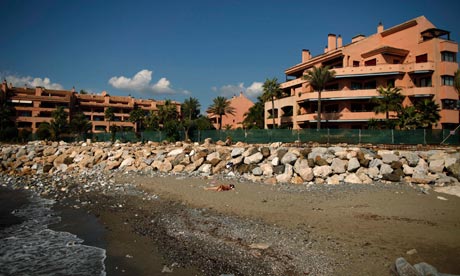 Entering the Andalucian property market is like entering a minefield. Some will emerge unscathed and others will step on the unexploded bomb. There is no reliable map to guide you. The tripwire for the unlucky is a poorly-policed system for urban planning and land management, which has resulted in an estimated 300,000 illegal buildings in this region of Spain alone. The consequences of owning an illegal property are many and varied, ranging from unexpected and expensive urbanisation costs to land grab, court proceedings, fines, denial of access to basic services or in the worst case scenario, demolition of your property. Since the problem emerged over a decade ago, the regional government has made efforts to cauterize the wound. It has introduced new regulations which attempt to ensure that mistakes are not repeated. However, it has thus far failed to effectively tackle the stockpile of illegal housing which continues to stink up the market place. Its latest legal manoeuvre, a draft decree, describes a complex, sometimes ambiguous, lengthy and expensive solution which fails to bring any immediate relief to those facing demolition or denied access to basic services. More decisive action is required in my view. The market demands it and the homeowners desperately need it. As president of AUAN (Abusos Urbanisticos Almanzora, NO), an association of some 700 British homeowners who have become trapped in this mess, I have a fairly detailed perspective on the problem and its possible solutions. I believe that the following should be done. Change the law The genie is out of the bottle and cannot be returned or ignored. The regional government must create a complete and up-to-date legal framework to deal with illegal constructions. This requires changes to the planning laws, rather than clarification of its finer details via various decrees. For example, current planning law does not recognise the existence of a house in the countryside unless it is associated with farming or is more than 25 years old. This does not conform to the needs of rural communities, the demands of the market or the current reality of homes in the countryside. Current planning law does not permit the segregation of a rural parcel of land to create a building plot. In reality, such parcels exist in large numbers, and must be dealt with to solve pressing problems with title to land and the property on it. Introduce interim measures Realistically, a properly-ordered solution will take years to implement. In the meantime, prosecutors are obligated to seek demolition of illegal properties and service providers are obligated to deny access to basic services such as electricity and water, creating untenable situations for the homeowner. Interim legal measures are required whilst fair and just solutions are put in place. Remove planning powers from small town councils In my experience small councils lack the funding and the technical expertise to prepare complicated town plans. There is also the frequently irresistible temptation to rezone the land of friends and family as lucrative building land at the expense of the wider community. A centralised function would create economies of scale and be more impartial. Act decisively against illegal construction It is easy to find examples of continued illegal construction. There are less than 50 planning inspectors in Andalucia for a land mass of 33,694 square miles. The complicated intermingling of politics, business, wealth and favours in small Spanish towns makes it unlikely that such activities will be reported. Citizens alerting the authorities to illegal construction need a means to protect their anonymity. Compensate Create a fund to compensate those whose homes have been demolished through failings in the system rather than any wrongdoing on the part of the unsuspecting homeowners. Divert money from marketing campaigns for this purpose. It will do more good. The government of Andalucia has complete control over planning matters within its borders. This gives them the power to amend the law to solve the problem. One can only hope that they heed the demand for change not only from Spanish nationals who are similarly affected and who will have their say in the coming elections, but also from the thousands of foreign homeowners who were encouraged to settle here only for their investment to be wiped out and their dreams shattered. If Spain wishes to remain the premier choice for European retirees and to bring in much needed new investment, it needs to make changes that will offer the security demanded by purchasers. If it continues to ignore the mistakes of the past or papers over the cracks with piecemeal legislation, consumers and the property industry as a whole will continue to be badly served.


 Lance-wielding Spanish townspeople speared a huge fighting bull to the death Tuesday, defying a lone protester who sprayed some of them with an irritant. Hundreds of people, many on horseback, turned out for the combat with a 608-kilogram (1,338-pound) black bull named Afligido — Spanish for Sorrowful — in the centuries-old "Toro de la Vega" festival. The massive beast charged through the fortified town of Tordesillas, central Spain, crossing a bridge over the River Duero and into a plain in a tradition that dates back to the Middle Ages. Before the lancing began, a female protester sprayed an irritant at some of those taking part before being taken away by police, a witness to the event said. The ritual, which has been held every second Tuesday in September since at least 1453, pressed ahead regardless and about a dozen lancers on foot and horseback attempted to spear the bull's flesh. One of the lancers on foot struck the first blow, conferring the right to lead the bloody, half-hour confrontation with the beast as others hemmed the animal in. The bull was finished off with a final blow to the head from a large screwdriver. Some 200 animal rights protesters later staged a rally in central Madrid to condemn the tradition, which predates the introduction of the classic bullfight at the end of the 17th century. The protesters, carrying banners showing their website "rompeunalanza.com", chanted "Tordesillas, national shame" before breaking wooden lances. "We are protesting over the celebration of the Toro de la Vega in which hundreds of people on foot and horseback lance a bull to death," said Silvia Barquero, spokeswoman for animal rights group PACMA. "We want the end of bullfighting and especially the Toro de la Vega which is even more savage than the bullfight," she said in an interview. Barquero said she believed the end of all bullfighting in Spain was approaching. The northeastern region of Catalonia will hold its last ever bullfight September 25 in Barcelona, after voting last year to end centuries of bullfighting — a first for mainland Spain. Opinion polls show most Spaniards do not approve of bullfighting, Barquero added, rejecting arguments that the bullfight is an essential part of Spanish culture. "Culture cannot be based in the torture and death of an animal. This festival is not supported by most Spanish people." PACMA challenges the Tordesillas town hall's decision in May to declare the Toro de la Vega as a cultural asset. Each region of Spain has responsibility for its own animal protection laws, usually with exceptions for bullfighting. The festival in Tordesillas is allowed under the laws of the Castilla y Leon region.


